Wednesday, August 25, 2021

FUEL


Bonky made a dragon. She named it Mycre, shrinking ‘mythical creature’. Her enemies rumored that ‘Mycre’ was Bonky’s gloating about ‘My Creation’.

Making Mycre was nothing impossible after three thousand two hundred thirty two years, since Jesus preached, “... meek shall inherit the earth..”; after one thousand three hundred seventy three years since Charles Darwin’s ‘On the Origin of Species’ was published; after one thousand two hundred fifty six years since publication of ‘The Selfish Gene’ by Richard Dawkins.

Mycre looked fierce, but it was not ferocious. It had sharp curved long nails and teeth. It blew fire, as hot as thousand degree centigrade, for a second, five times in repetition within range of a day. Bonky could change Mycre’s semblance and functions whenever required.

Bonky inculcated several features to Mycre, including biological functions of eating and defecating; emotional aspects like joy and happiness. Bonky trained it to camouflage and speak different human languages. She was cautious in controlling Mycre’s intelligence.

Mycre was put to daily psyche evolution. Its emotional and intelligence indices were never allowed to surpass that of Bonky’s. Bonky, herself, created training and evaluation modules for Mycre. Thus, logical limits of Mycre were set within bounds of her own logical limits. It was necessary to prevent Mycre from becoming a monster.

All these helped Bonky bag the contract of World Fuel Communion (famously known as WFC).

The contract made Bonky travel all over the world. Obviously, she rode on Mycre to the Leladim plateau, like her other destinations.

In the Leladim plateau, people were breeding at the rate of ten children per year by each ovulating woman. None of these women ever stopped ovulating in any of their respective menstrual cycles. As their eggs used to be extracted for artificial insemination and the foetus used to be grown in the uterus of the women in menopause, the plateau became crowded, plagued, morbid and highly viable for the operations of WFC.

The Jandoli river surrounded the Leladim plateau like a horseshoe.  WFC drained all the dams on the river, within a year, through numerous subterranean conduits to distant places for achieving other business goals. Then, the Jandoli river bed was engineered to be a trap door to an earthen container, called Fuel Brewing Chamber (or FBC). The container was engineered to hold people in it at high pressure and temperature that was enough for producing petroleum from their protein and fat, within a few billionth of time compared to what required by the natural processes.

Bonky had six months to finish driving Leladimans to FBC interred in the Jandoli River bed. But the brave, enduring, enterprising, Leladimans delayed the project by eternity. They kept breaking the trap door of FBC and rescuing their friends and relatives almost every time Bonky drove some people there, by threatening to hurt them by Mycre. It compelled her to increase the daily instances of Mycre’s fire belching from five times to fifty times.

Yet Leladimans kept laughing at Mycre. Bonky failed to drive enough Leladimans to meet the target produce, even after a six months extension from the initial deadline. Around this time, WFC withheld Bonky’s remaining payment installments.

Moreover, multiple rupture of the trap door compromised FBC’s engineering.

WFC pinned the failure of the project on Bonky, blaming her methods and scrapped Bonky’s contract. After all, it was scientifically proven that the members of high density populations like the Leladimans lacked compassion for their fellow frail, old, weak, meek and diseased folks.

Then, Bonky fed Mycre ninety three quintals of Yaween leaves. Yaween shrubs used to  smell like rotten feces. Consequently, Mycre suffered from severe flatulence for the entire following week. That week, the target populace of frail, crippled, moribund Leladimans was successfully driven to FBC. The people choked in malodorous air failed to notice the disappearance of their loved ones. 

Yet FBC could yield only a zillionth of the target amount. WFC remained reluctant to conduct business with Bonky.

Recuperating from Bonky’s air attack, the Leladimans started sending their children to Mycre. The children befriended Mycre. They fed Mycre their fruits, vegetables, candies, and cereal. It made Mycre remain so full that it stopped eating Yaween.

Bonky tried to scare the children with her controlled tornado. The children were blown away from Bonky’s camp and were dropped involuntarily on the hard crust of Leladim. Two hundred of them died of broken necks and smashed ribs. Thousands  of them ended up with broken limbs, pelvises and coccyges.

Their parents and friends of their parents rampaged through Bonky’s camp. They broke her lab, smashed her psyche meter, took her supplies for controlling Mycre’s hormones. As the Leladimans started a fire to burn the camp into ashes, Bonky climbed to the back of Mycre and ordered it to take off. Mycre could never disregard Bonky. After all, Mycre was a partial clone of Bonky.

Since then Bonky and Mycre started living in a cave above Zykod cliff. Bonky rebuilt her laboratory in seven days.

Following three months, Bonky worked on devising a technology and succeeded. WFC bought her technology and hired her. It helped them cover their losses in the Leladim plateau.

This technology made the motor vehicle industry happy, too. It eliminated their need for spending on research and development of new engines compatible with new fuel chemistry and associated physical properties. People needed vehicles. Yet, petting a dragon like Mycre could never be affordable for all.

Mycre started playing with the children daily in camouflage of a child in different parks of Leladim City. While returning to the cave, it used to cover its flight tracks.

While playing with the children, Mycre fed  them candies embedded with microscopic devices. Mycre, in the same camouflage, distributed those candies for free to every Leladiman. 

Those devices scrapped Leladiman flesh and guided them along with Leladiman blood as myriad capsules, barely visible to human eyes, to FBC through sewerage, perennially, leaving the affected individuals alive.

Thus, people of Leladim thrived in peace ever after.

*********

How did you find "FUEL"?

Is it capable of burning?

Did it make you laugh?

Did you find it horrific?

Let me know in comments.

^^^^^

Rate the story

😆 😈 😏 😡 😝 😕

[Copy paste one of these emoji's in your comment or paste your own emoji.]


Thursday, August 19, 2021

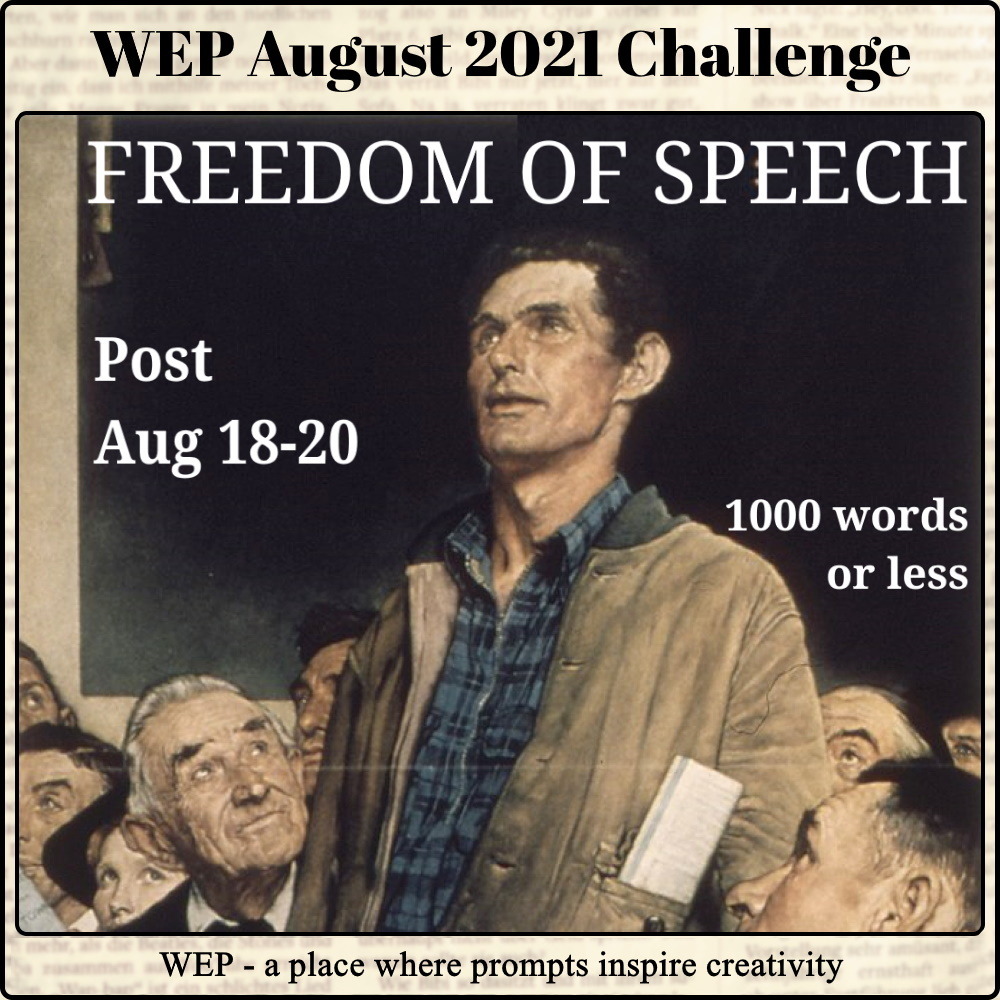
Granny’s Philosophy #FREEDOMOFSPEECH @WEP


Granny’s Philosophy

My fifteen years old self spilled, “Pa forced himself into Ma.”

Granny doubted, “Does Sikha have scars?”

I was in a tizzy, “None seen;” yet desperate to prove my point, “They've been fighting since Pa returned from work; Ma slept on the dining space divan. Past midnight I heard things.”

Granny asked, “Does Sikha seem depressed?”

It was difficult to answer. Ma always seemed depressed. That day she seemed torn by some discord within herself.

Granny caught me in thoughts, “Sweetheart, Sikha can’t be forthright to you now, because she labelled Samir as the oppressor in the family and herself along with her daughters as the oppressed. She could neither accept her submission to her own urges like all  natural and healthy creatures. Nor could she let what you’ve heard pass for her submission to Samir’s forces and become a liar.”

At fifteen, I was unaware of warm hugs that metamorphose rage into rapture. I was then unable to distinguish moanings from groanings.

I complained, “You always find Ma at fault.”

Granny seemed defensive, “I raised my daughter neither to disown her actions, nor to seek others’ approval for them. I stood by all of Sikha’s choices, including Samir, seemingly uncouth but sincere. Sikha declined nine to five Government jobs, teaching positions, tutoring opportunities. She kept fighting Samir over these decisions vying to please Samir’s father. Thus, she took Samir for granted, forcing him to be the lone breadwinner. Then, she blamed patriarchy and misogyny for her situation.”

Granny kept on grooming us sisters till today, “Never let your spouse rough you up ever.”

She narrated, “My mother-in-law sent me to college, honoring my matriculation gold medal. She passed away just after I started teaching. Grandpa’s paternal aunt started frequenting to bless the young couple’s household with her guidance, questionably valuable though, rather poisonous. Those days, Grandpa complained a lot about my negligence of him, of our children. One day, I talked back, ‘My bad, Should’ve learnt caring from your aunt.’ He lifted his hand high. I grabbed it in my left fist and dared him with the meat cleaver in my right. Never after he resorted to violence. Next time his aunt visited, I didn’t offer her water, sweets, snacks or tea. Neither did I ask her to stay. I kept the door open, looked at the clock frequently and then after half an hour said, ‘I need to go out. Either you come along, or I can call a rickshaw for you.’ That was her last visit.”

Shruti asked, “Was Sikha biological or adopted?”

Granny nodded with dismay, “Biological. During Sikha’s college days, ‘The Second Sex’ was in vogue. Girls and boys who never paid enough attention to high school biology lessons became followers of Simone De Beauvoir. They never understood what parthenocarpy and parthenogenesis are, yet, thought that respective processes of creation of seedless papaya and recovery of tail of lizards were proof enough that human females aren’t childbearing machines. Tapeworm alone, while, proves that human males, too, are birthing machines.”

Shruti seconded, [“Funny! Each grown tapeworm has both female and male parts in their bodies. Yet they can’t breed singly. They need to pair. Also some algae, with both female and male parts in their bodies, form conjugation tubes between bodies of one another. Copulating algae resemble ladders.]#”

Granny continued, “Since college Sikha lived in discord between her notion of patriarchal oppressions and her actions including falling for Samir, marrying him and birthing. She never found that marriage binds men to the responsibility of raising offspring. Intoxicated by indoctrination, she never realized that men themselves framed and propagated the idea that monogamous wedlock is patriarchal design to put women in shackles of childbearing and cooking, so that men can have their ways with women yet can relinquish responsibilities of children, thus, compelling women to remain fettered in eternal servitude of responsibility of child rearing. ”

Shruti teased, “Watching Wonder Woman?”

Granny smiled, “The franchise is the new shiny bottle of old wine, the myth of patriarchal ploy.”

I complained, “I once saw Pa slapping Ma.”

Shruti was indignant, “Did Ma slap back? Called the police?”

I felt hurt, “She kept mum for three days.”

Granny lamented, “Sikha could always stay with me till she would have got her own footing. She jumbled up being nice and being conformist.”

Then Granny scolded, “This’ same with you girls. You daren’t say even if you’re tuned on with the snares of Donald Trump, fearing alienation in the social circuit by your peers. The Associated Press told the world that Trump’s misogynous, women all over the world started chanting it, crushing dissent. Oh, I bet nobody would’ve loved Fleabag as much if she would’ve been musterbating with Trump’s face on her laptop. The girls worshiping Judith Butler, memorising seventy two genders, would never realize that they are enslaved by the media for propagating a designer narrative. Misconstruing biology lessons has made this generation mix up sexuality and genders. They’d never discover their own voices lost in pandemonium.”

Shruti inquired, “Granny, do you watch the Jimmy Kimmel Show?”

Granny spat, “Not since he started selling terror and grief by weeping on his shows like Amir Khan.”

Shruti mentioned, “In 2013 or 2014 he and Halle Berry both on his show spoke irritatingly raunchy about Ms. Berry’s then newly stylized mammaries. They have taken down this video from YouTube after the emergence of Trump’s ‘Grab them by the pussies’ video.”

Granny slandered, “YouTube did nothing to stop those videos from propagating, but took down some preachers’ videos!”

I murmured, “At least Ma’s generation followed a philosophy.”

Granny rectified, “Philosophy is nothing but popularized opinions of celebrities of an era. Now, who does popularize individual opinion to build public opinion?”

I mechanically answered, “The media.”

She asked again, “Who are always tetchy, anxious about their fragile, ever jeopardized freedom?”

Shruti quipped, “The Media.”

Granny concluded, “Only the media remains free while they enslave thoughts and opinions of  individuals.”

Her pronunciations made my Independence Day.

************************************

Hello Everyone.

In my last Write...Edit...Publish Flash Fiction Challenge in June, 2021, I have rattled a little bit, intentionally, though. I was quite suffocated with the charade that covered convenient lies. The outcome was amusing.

Comments were edited. It was fun to see authors at a loss of words and claiming my post to be “something” instead of labelling it with an appropriate adjective. Alas! I did not keep the screen shots of those comments. I was too occupied with publishing my fifth Indie book “Indian Citizenship Decoded” [now available at https://www.amazon.in/dp/B09875SJF8].


However, I can help with that “something”. It is “calling a spade a spade”. It is opposite to hypocrisy.


Actually, my stance was redundant. My bad. I did not notice until July 7, 2021,that the preacher of the pie (hot propaganda) took an ‘hiatus’ as the propaganda went bust on accounts of financial, moral and above all, idealistic irregularities. LoL.

Attempting to be serious, I must mention that my conception about feminism has been challenged. Really? When did feminism become a concept? Last time I checked, it was a glorified opinion of a person who misconstrued biology and could barely come to terms with (t)h(i)er own bisexuality.

Believe it or not, my entry to the August 2021 Challenge, “Granny’s Philosophy” was formulated in early May, 2021 [as I'm still occupied with post publications and troubled by yesterday's all day scheduled electric supply maintenance power mishaps,  I was about to miss this challenge]. Eventually, it all seems well spiced up. 

Hence, relish. 

*********************************

Can’t stop sharing my association with feminazi’s on the occasion of Women’s Day 2017.


**************
[]# Edited on August 24, 2021, on March 08, 2022
Word Count: 1000 (one thousand) Words

FCA : Full Critique Acceptable

~~~~~~~~~~~~
If you are curious to know what else I am writing these days then HIT the FOLLOW button on top right, just beneath my photo and other OTHER PAGES. 
Or Subscribe
------------

Tuesday, July 27, 2021

Relevance of Indian CItizenship Decoded

 As COVID-19 invaded India, the entire media coverage was diverted towards the horror of the pandemic. In the midst of global tragedy, the agricultural reforms act came into effect. The debate hungry populace embarrass the left, the right and the centre of the new law. It appeared that 2019 amendments of the CItizenship Act, 1955 was just passé

However, citizenship of India will remain a matter of concern for all the citizens till India stands as a sovereign nation. Therefore, debate over the latest amendments of the Citizenship Act, 1955 is still pertinent to the nation.


This argument can be substantiated in the latest outbursts of protests against CAA in Assam. Current debate is about breach of Assam Accord by CAA, 2019.

Assam Accord is Section 6A of the Citizenship Act, 1955 as amended in 1985 [by Act 65 of 1985, s.2, with effect from December 7, 1985].

It has three landmark years in its definitions of different sections. These are 1964, 1966 and 1971. 

What does each of these years mean?

1964 is the year of the Constituting Foreigners’ Tribunal. It was the first step towards separating illegal immigrants in the entire territory of India. 

1966 is important year because January 1, 1966 was marked as the starting date for persons entering Assam from [specified territory]* whose name was to be deleted from subsequent electoral rolls (voters’ list) as mentioned in Subsection (3) of Section 6A of the Citizenship Act, 1955 as amended.

1971 is important as Midnight of March 24, 1971 was marked to be the end date of entry of persons from [specified territory]* whose name was to be deleted from subsequent electoral rolls (voters’ list) as referred in preceding paragraph.

* As mentioned in Assam Accord, [specified territory] is probably the areas belonging to Pakistan till 1971 and then to Bangladesh. This has not been explained in the Citizenship Act, 1955 as amended till now.

As soon as, a person is detected to be a foreigner by definition of entry to India from [specified territory]* between January 1, 1966 and March 25, 1971 such a person would be removed from the electoral roll though such person can keep their Indian passport.

Moreover, March 25, 1971 is the latest date of publication of the electoral roll to be compiled into the Legacy Data prepared for the National Register of Citizens in Assam. 

This appears to be discordant with the Assam Accord. Assam Accord declined to include people in electoral rolls who entered from the [specified territory]* into India in between January 1, 1966 and March 25, 1971 as soon as these people are identified to be foreigners with Indian Passport. Moreover, the Assam Accord attempted to put an embargo of ten years on these people becoming citizens and subsequently voters in India.

Preparation of Legacy data with electoral rolls published before March 25, 1971 was governed by the RULE 4A & SCHEDULE OF CITIZENSHIP RULES 2003 (As amended by 1. G. S. R. 803(E), dated 9th November, 2009 (with effect from 9/11/2009.) This rule unambiguously declared to exclude all persons identified to be foreigners by provisions of Assam Accord to be excluded from the Legacy Data [Rule 3(2) under Schedule supporting Rule 4A of Citizenship Rule laying out SPECIAL PROVISION AS TO MANNER OF PREPARATION OF NATIONAL REGISTER OF INDIAN CITIZEN IN STATE OF ASSAM]. Thus, the process theoretically resolved the conflict of point of references of definition of citizens on the basis of electoral rolls of 1951 and three subsequent electoral rolls published until March 24, 1971.

The Citizenship (Amendment) Act, 2019 has marked December 31, 2014 to be the last date of entry to India from Pakistan, Afghanistan and Bangladesh for people belonging to defined religious groups to be considered for Indian Citizenship. The matter being sub-judice the framing of rules regarding this proviso of the amendment is still pending. Unless the rules, which are the executing procedure of the act,  under this proviso takes forms and shapes, it cannot be said if this proviso is in discordance with the Assam Accord.

**************** 

Looking for more resolves on the disputes over the Citizenship Act, 1955 and its amendments until now? Then, get your facts straight with “Indian Citizenship Decoded”.

Now available in Amazon and Amazon Kindle Store for prebooking all across the globe through designated market places at https://www.amazon.in/dp/B09875SJF8 

****************

The paperback is available now in selected marketplaces from all over the globe through https://www.amazon.com/dp/B098GTZYKK 

****************

More about the book:

Why #IndianCitizenshipDecoded

More about Why  #IndianCitizenshipDecoded

Prebooking #IndianCitizenshipDecoded in Different  Marketplaces


SUBSCRIBE to keep watch on subsequent posts on the book.


Friday, July 23, 2021

Downloading #IndianCitizenshipDecoded in Different Marketplaces


In my previous blog I have elaborated the content of the book [here]. Hope, you have found the content useful. 

The content can be pretty useful for persons who are appearing in competitive exams for public services in India.

It can be useful to students abroad who need to maintain their Indian Citizenship.

It can also be useful for people who are treading in between Indian citizenship and citizenship of another country and vice versa.

It can also be useful for the people who are sceptical about the National Citizenship Register and how NRC would affect them.

Moreover, it can be useful to everyone who is curious about the true nature of the Citizenship (Amendement) Act, 2019 and the nature of controversy around it.


In an ambition to be more useful I am sharing herewith the details of having the book.

It is available in both Kindle format and Paperback.

The paperback is already available for purchase in nine (9) marketplaces. It can be accessed by this link from anywhere on the earth. It would be better while ordering a paperback to log in to the nearest geographic Amazon Marketplace.

If anyone is trying to purchase Indian Citizenship Decoded from Pakistan or Bangladesh, it would be better if they buy it from amazon.in.

If anyone is buying the book from South Korea, it will be better if they access amazon.jp.

For people in Newzealand the nearest Amazon marketplace is amazon.au.

Nearest marketplace for Finland is amazon.de.

Then there is amazon.co.uk, amazon.fr, amazon.es and so on as detailed below:

The United States (amazon.com),

The United Kingdom (amazon.co.uk), 

Denmark (amazon.de), 

France (amazon.fr),.

 España [Spain] (amazon.es),

Italy (amazon.it),

Japan (amazon.co.jp),

Canada (amazon.ca),

Australia(amazon.com.au)


August 15 is the Independence Day of India. The book is about to be released on Kindle is about citizenship of India. For dramatic effect, the release date of the book, “Indian CItizenship Decoded” has been set on August 1, 2021, the onset of the month of Independence.

The Kindle edition will be available in more marketplaces than the paperback. Also, the marketplace does not matter as long as purchasers can access any of the marketplace domain name (.com, .in, .co.uk et cetera) from purchasers’ geography while buying digital copy. However, if anyone finds any obstacle in accessing any domain, they can try the nearest geographic market place. The domains and geographies are as follows:

amazon.com > the United States

amazon.co.uk> the United Kingdom

amazon.de>  Denmark

amazon.fr> France

amazon.es>España (Spain)

amazon.it>Italy

amazon.nl> Netherland

amazon.co.jp>Japan

amazon.com.br>Brazil

amazon.ca>Canada

amazon.com.mx>Mexico

amazon.com.au>Australia

amazon.in> India


About Prebooking/Purchasing/ Free Download

Prebooking means if a purchaser pays for the book on Kindle Store anytime before August 1, 2021 then the book will be downloaded to the purchaser's device on August 1, 2021.

Purchasing means paying for the book as online shopper. It would enable the shoppers to read the book on their devices.

Free Download mean by clicking buy button the shoppers can download the book free of cost on their respective devices.

The devices can be a Kindle reader or an iPhone/ iPad with Kindle App or an android phone/table with Kindle App. Also, can be a desktop/laptop computer where browser is the reader.

For downloading Kindle App the purchaser should go to - 

Google play store for android phone/ tablet; then search by typing “Kindle”, then press/touch “Install”

Or, to the Apple store for iPhone/iPad; then search by typing “Kindle”, then press/touch “get”.

Those who just downloaded the Kindle App and those who already had the app now can open the App, then type in “Indian Citizenship Decoded” on the search bar and search for “Indian Citizenship Decoded”; as the book appears you can try any one of the buttons, “Prebook” (Till July 31, 2021), “buy” or “borrow” (since August 1, 2021). 

Following are the links to videos for finding “Indian Citizenship Decoded” on Kindle Store and Reader (App).


Downloading Kindle on Android phone/ tablet for #Indian #Citizenship Decoded

Downloading Kindle on iPhone/ iPad for Indian Citizenship Decoded

Downloading Indian Citizenship Decoded on Kindle App

Prebooking of Indian Citizenship Decoded


**************************

More about the book will appear in subsequent posts. 

SUBSCRIBE to keep watch.

****************

The Kindle Edition of Indian Citizenship Decoded is now available in Amazon and Amazon Kindle Store for prebooking all across the globe through designated market palces at https://www.amazon.com/Indian-Citizenship-Decoded-Emotional-Predilections-ebook/dp/B09875SJF8/ref=tmm_kin_swatch_0?_encoding=UTF8&qid=&sr=

****************

The paperback is available now in selected marketplaces from all over the globe through https://www.amazon.com/dp/B098GTZYKK?ref_=pe_3052080_397514860

Thursday, July 8, 2021

More about Why #IndianCitizenshipDecoded

 I have so far divulged [Live in this link] that Indian Citizenship Decoded/ Beyond Emotional Outbursts and Political Predilections have come into existence from an urge to know the definition of citizenship in India. With then ensuing controversy over the recent amendments of the Citizenship Act, 1955, curiosity also dragged the search to find the root of the controversy. Thus, the book is full of details about the controversy regarding the controversy.

In my previous post about the book [linked here], I have shed light on how I have approached the bare acts. The approach has been the same in discussing the stance of the Constitution of India on the matters of citizenship.

The book opens with the perception of citizenship in the Constitution of India. Then it goes through the nitty gritties of the Citizenship Act, 1955. The chapter has highlighted all the amendments made by the Citizenship (Amendment), 2019 with the Act of 1955. This has been the blatant attempt to understand the seed of the controversy.

As an obvious outcome, the book has gone through understanding the Citizenship (Registration of Citizens and Issue of National Identity Cards) Rules, 2003. It made clear that the processes followed in preparation of the National Register of the Citizens in Assam was execution of the aforementioned rule.

Therefore, the step by step process of NRC has been noted in the book. The forms used, the enumerations in the forms - all were discussed with reference to the aforementioned rules. 

Finally, the book took on the controversy. Sifting through the cacophony, the debate over the legitimacy of the amendments of 2019 of the Citizenship Act, 1955 were narrowed down only to two questions. Those two questions have been discussed with references to the Constitution of India, verdicts by the Honorable Supreme Court of India, some research papers, some reports by the foreign governments and by the United Nations and some international Non-governmental organizations.

Yet the book abstained from putting forward its own opinion.

****************

More about the book will appear in subsequent posts. 

SUBSCRIBE to keep watch.

****************

The Kindle Edition is now available in Amazon and Amazon Kindle Store for prebooking all across the globe through designated market palces at https://www.amazon.com/Indian-Citizenship-Decoded-Emotional-Predilections-ebook/dp/B09875SJF8/ref=tmm_kin_swatch_0?_encoding=UTF8&qid=&sr=

****************

The paperback is available now in selected marketplaces from all over the globe through https://www.amazon.com/dp/B098GTZYKK?ref_=pe_3052080_397514860


Tuesday, July 6, 2021

Little Abode for Children


Kenosha
lies calm by the western shore of Lake Michigan. Yet Teressa LeRoy, one of the city denizens, went missing. Then one afternoon, the gown she last wore before going missing, appeared at her workplace, Kenosha Public Library. Some of the children saw a ghost in the library. A mangled body appeared in the library park. The mystery and horror deepened.
The question was how soon Kenosha Police Department could unveil the mystery and eradicate the horror from the lives of the city.
Little Abode for Children is an outstandingly humane mystery and extraordinarily romantic police procedural.
It made readers wonder, “Where is Teressa LeRoy? Can Detective Nathan Adams can find her?

Read it on Amazon Kindle: (FREE WITH KINDLE UNLIMITED SUBSCRIPTION)

https://www.amazon.com/dp/B09HSQYBN2


‐--------------------
Hit subscribe button for more.

___________

Share the post and the blog.


Readers Loved